
Samsung vs Xiaomi: Which Phone Brand Is Better?
Choosing a new smartphone can feel surprisingly difficult. You walk into a store or open an online shop and suddenly there are dozens of phones promising fast performance, excellent cameras, beautiful displays, huge batteries, and “flagship-level” features. Two names that frequently appear at the top of the list are Samsung and Xiaomi. Both brands offer smartphones across different price ranges, but they approach the market in very different ways.
So, Samsung vs Xiaomi: which phone brand is better? The honest answer is that it depends on what you value most. Samsung generally has a strong reputation for polished software, displays, cameras, long-term support, and a broad ecosystem of devices. Xiaomi, on the other hand, is particularly aggressive with hardware specifications, battery capacity, charging speeds, and value for money.
For example, Samsung’s Galaxy A56 5G features a 6.7-inch Super AMOLED display with a 120Hz refresh rate, a 50MP main camera with OIS, a 5,000mAh battery, and support for up to six generations of OS upgrades and six years of security updates. Xiaomi’s Redmi Note 14 Pro in Pakistan offers a 6.67-inch AMOLED 120Hz display, a 200MP main camera with OIS, a 5,500mAh battery, and 45W charging.
That comparison alone tells us something important: there is no universal winner. Samsung can be the better choice for someone who wants a refined, dependable long-term experience, while Xiaomi can be the smarter option for someone who wants maximum hardware for their money.
Samsung vs Xiaomi at a Glance
Samsung and Xiaomi have built their reputations around different strengths. Samsung has spent years developing the Galaxy ecosystem, from affordable Galaxy A-series phones to premium Galaxy S and Z-series devices. Xiaomi has built a reputation for packing impressive specifications into competitively priced smartphones, particularly through its Redmi and Xiaomi series.
If you care about software polish, long-term updates, camera consistency, display quality, and integration with accessories such as Galaxy Buds and Galaxy Watches, Samsung is usually an attractive option. Samsung’s current Galaxy A56 5G, for instance, supports up to six generations of OS upgrades and six years of security updates, which is a significant advantage for people who keep their phones for several years.
Xiaomi’s approach is slightly different. The company often tries to make the specification sheet look extremely attractive, offering features such as high-resolution cameras, large batteries, fast charging, high-refresh-rate displays, and additional hardware features at competitive prices. The Redmi Note 14 Pro, for example, includes a 200MP main camera, a 5,500mAh battery, 45W charging, a 120Hz AMOLED display, NFC, stereo speakers, and an IR blaster in its Pakistan-market specification.
What Makes These Brands Different?
Think of Samsung as the phone brand that often tries to deliver the complete package, while Xiaomi frequently tries to make the specification sheet difficult to ignore.
That doesn’t mean Xiaomi phones are poorly built or Samsung phones always have better hardware. In fact, Xiaomi can win individual specification battles quite easily. A Xiaomi phone might have a larger battery or a much higher megapixel count, while Samsung may offer better software support or a more consistent camera experience.
This difference matters because buying a smartphone isn’t simply about counting numbers. A 200MP camera doesn’t automatically produce better photographs than a 50MP camera. A 5,500mAh battery doesn’t automatically guarantee longer real-world battery life. And a fast processor doesn’t mean much if the software isn’t optimized properly.
The best phone is the one that balances the things you actually use every day.
Samsung vs Xiaomi: Performance
Performance is one of the most important factors when buying a smartphone. Whether you’re switching between social media apps, watching YouTube, editing photos, using navigation, or playing demanding games, you want a phone that feels responsive.
Samsung’s current mid-range Galaxy A56 5G uses an octa-core processor with CPU speeds reaching 2.9GHz, while Xiaomi’s Redmi Note 14 Pro in Pakistan uses the MediaTek Helio G100-Ultra with a maximum CPU speed of 2.2GHz.
However, comparing processor clock speeds alone would be misleading. Different chip architectures, GPUs, memory configurations, software optimization, and thermal management all influence actual performance. This is why you shouldn’t decide between Samsung and Xiaomi just by looking at the “GHz” number on a specification sheet.
For normal daily tasks, both brands offer phones capable of handling messaging, social media, streaming, browsing, photography, and multitasking. The difference becomes more noticeable when you move into demanding gaming, intensive video editing, or long periods of heavy use.
Which Brand Is Better for Gaming?
For gaming, the answer depends heavily on the exact models being compared rather than the logo on the back.
Xiaomi has traditionally been attractive to gamers looking for strong specifications at lower prices. Many Xiaomi and Redmi models prioritize large displays, high refresh rates, capable chipsets, and large batteries. Samsung also offers powerful gaming phones, particularly in its Galaxy S series, but its budget and mid-range models are not always designed around maximum gaming performance.
If your priority is gaming and you’re shopping on a strict budget, Xiaomi deserves serious consideration. If you want a premium gaming experience alongside excellent software, cameras, display quality, and ecosystem features, Samsung’s higher-end Galaxy devices become much more competitive.
In simple terms, Xiaomi often makes value-focused buyers feel like they’re getting more hardware, while Samsung’s premium models aim for a broader flagship experience.
Display Quality
Both Samsung and Xiaomi make excellent smartphone displays, but Samsung has one of the strongest reputations in the display industry.
The Galaxy A56 5G, for example, uses a 6.7-inch FHD+ Super AMOLED panel with a 120Hz refresh rate. Xiaomi’s Redmi Note 14 Pro offers a 6.67-inch AMOLED display with 120Hz refresh, 10-bit color depth, DCI-P3 coverage, and up to 1,800 nits peak brightness according to Xiaomi Pakistan’s specifications.
Both specifications look impressive on paper, and they translate into smooth scrolling, strong colors, and a much more enjoyable experience than older 60Hz LCD phones.
Samsung’s AMOLED Advantage
Samsung’s display technology has become one of the company’s biggest selling points. Colors tend to look vibrant, blacks are deep, and AMOLED panels can provide a premium visual experience for movies, games, photographs, and everyday scrolling.
That doesn’t mean Xiaomi is far behind. Xiaomi is increasingly putting high-quality AMOLED panels into phones that compete aggressively on price. The Redmi Note 14 Pro specification sheet demonstrates just how much display technology buyers can get without automatically moving into premium flagship pricing.
For most buyers, both brands can provide excellent displays. Samsung gets the edge if display consistency and overall refinement are your highest priorities, while Xiaomi can be the more exciting choice when you’re comparing features against price.
Camera Performance
Camera performance is where smartphone comparisons become particularly interesting.
Samsung and Xiaomi use very different strategies. Samsung often focuses on balanced image processing, reliable autofocus, natural-looking results, strong video capabilities, and consistent performance between cameras. Xiaomi frequently pushes impressive camera hardware, including high-resolution sensors.
Take two examples. The Galaxy A56 5G has a 50MP main camera with optical image stabilization, a 12MP ultra-wide camera, and a 5MP macro camera. It can also record 4K video at 30fps.
The Redmi Note 14 Pro available in Pakistan features a 200MP main camera with OIS, an 8MP ultra-wide camera, and a 2MP macro camera.
At first glance, Xiaomi appears to win because 200MP sounds much bigger than 50MP. But megapixels aren’t the whole story. Image processing, sensor size, stabilization, lens quality, autofocus, dynamic range, and software all affect the final photograph.
For social media photography, travel photos, portraits, and casual everyday shots, Samsung is often the safer all-round choice. Xiaomi can be extremely impressive when lighting conditions are good and you want highly detailed images.
Battery Life and Charging
Battery life is another category where Xiaomi can be extremely attractive.
The Redmi Note 14 Pro listed by Xiaomi Pakistan comes with a 5,500mAh battery and 45W turbo charging, with the charger included in the listed package.
Samsung’s Galaxy A56 5G has a 5,000mAh battery and Samsung rates it for up to 29 hours of video playback.
On paper, Xiaomi has the larger battery. But battery capacity isn’t the only factor determining endurance. Screen brightness, processor efficiency, network conditions, background applications, refresh rate, and software optimization all influence how long a phone lasts.
For someone who spends hours away from a charger, Xiaomi’s larger battery and fast charging can be very appealing. Samsung’s battery performance is also strong, particularly when the phone is well optimized for everyday use.
If charging speed and battery capacity are your biggest concerns, Xiaomi often has the advantage. If you want dependable all-day endurance combined with long-term software support, Samsung remains a strong choice.
Software and User Experience
Software is one of the biggest differences between Samsung and Xiaomi.
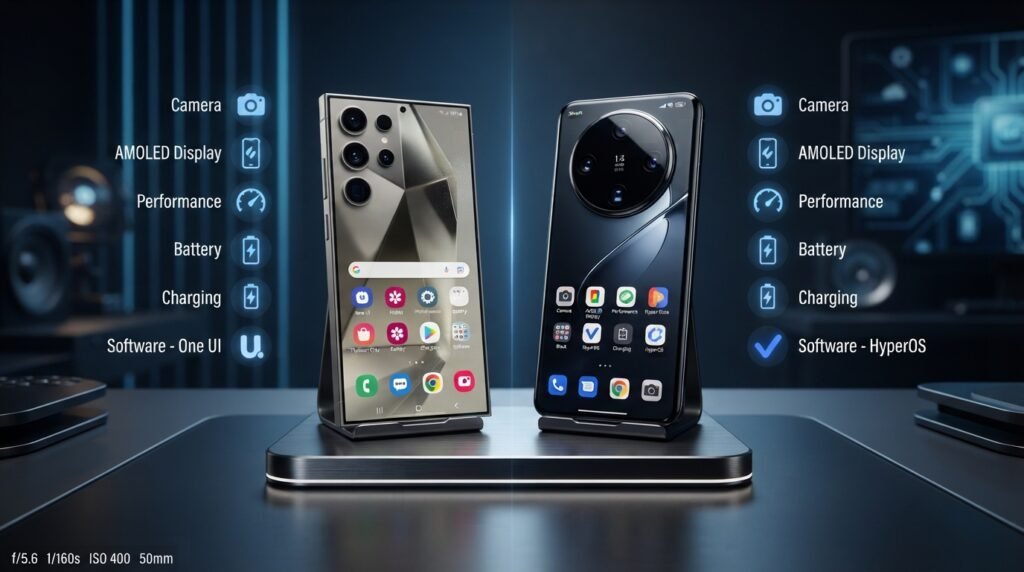
Samsung uses One UI, while Xiaomi uses HyperOS. Both are based on Android, but the experience feels different.
Samsung’s One UI is known for its mature design, extensive customization options, strong integration with Galaxy devices, and a polished overall interface. Samsung also has a significant advantage in long-term support on many newer devices. The Galaxy A56 5G, for example, is advertised with up to six generations of OS upgrades and six years of security updates.
Xiaomi’s HyperOS provides its own visual style and a wide selection of features. Xiaomi also integrates additional hardware features into some phones, such as the IR blaster found on the Redmi Note 14 Pro.
For users who want a phone that will remain supported for many years, Samsung’s software commitment can be a major reason to choose Galaxy.
Updates and Long-Term Support
This is an area where buyers should look beyond launch-day specifications.
A smartphone isn’t just something you buy today; it is something you may use for three, four, or even five years. Regular software and security updates can make a meaningful difference over that period.
Samsung has made long-term support a major part of its smartphone strategy. Its Galaxy A56 5G is officially listed with six generations of OS upgrades and six years of security updates.
That makes Samsung particularly appealing to users who don’t replace their phones every year.
Xiaomi has improved its software experience substantially, but support can vary by model and market. Therefore, if long-term updates are one of your top priorities, always check the exact model’s official support policy before buying.
Design and Build Quality
Design is subjective, but both Samsung and Xiaomi have become increasingly competitive.
Samsung tends to focus on a clean, understated design language across its Galaxy range. The Galaxy A56 5G, for example, has a slim 7.4mm body and weighs 198 grams.
Xiaomi takes a more specification-driven approach across its Redmi lineup, but modern Redmi phones can still look surprisingly premium. The Redmi Note 14 Pro listed by Xiaomi Pakistan weighs 180 grams and is approximately 8.24mm thick.
The important thing is not simply which phone looks better in photographs. Consider how the phone feels in your hand, whether the camera bump bothers you, how slippery the back is, and whether the device has the water and dust resistance you need.
Xiaomi’s Redmi Note 14 Pro is listed with IP64 protection in Pakistan, while Samsung’s protection level depends on the specific Galaxy model.
Features and Connectivity
Modern smartphones have become much more than communication devices.
Samsung provides access to a large Galaxy ecosystem that includes smartwatches, earbuds, tablets, and other connected devices. The Galaxy A56 5G supports features and accessories within Samsung’s broader ecosystem, making it attractive for users who already own Galaxy products.
Xiaomi also offers useful extras. The Redmi Note 14 Pro specification includes NFC, an IR blaster, stereo speakers, an in-screen fingerprint sensor, Bluetooth 5.3, and expandable storage support through a hybrid SIM/microSD configuration in the Pakistan specification.
That IR blaster is a small but practical example of Xiaomi’s approach. You may not care about it at all, but if you want to control a compatible TV or air conditioner using your phone, it can be surprisingly useful.
Price and Value for Money
This is probably the biggest reason many people compare Samsung and Xiaomi in the first place.
Xiaomi has built a strong reputation for delivering aggressive specifications at competitive prices. Buyers can often find large batteries, high-refresh-rate AMOLED displays, high-resolution cameras, and generous storage without moving into the most expensive smartphone categories.
Samsung competes differently. While Galaxy phones can sometimes cost more than similarly positioned Xiaomi models, buyers are also paying for Samsung’s software experience, brand ecosystem, display technology, camera processing, after-sales presence, and long-term update policy.
So, which one gives you better value?
If value means maximum hardware for your money, Xiaomi often deserves the win.
If value means how useful and supported the phone remains over several years, Samsung can become much more attractive.
That distinction is important. A cheaper phone isn’t automatically better value if you replace it sooner.
Samsung vs Xiaomi in Pakistan
For Pakistani smartphone buyers, price, official availability, warranty, PTA status, and after-sales support can be just as important as specifications.
A phone that looks amazing on an international website isn’t necessarily the best purchase if obtaining official warranty support becomes difficult. Buyers should check the exact local variant, official warranty terms, PTA approval status, and current retail pricing before making a final decision.
Samsung has a long-established presence in Pakistan, while Xiaomi also has a strong footprint with Redmi and Xiaomi smartphones.
Local pricing can change frequently because of currency fluctuations, promotions, retailer margins, and new product launches. That’s why it’s better to compare the current local price of the exact models rather than relying on an old price mentioned in an article.
Which Brand Is Better for Students?
For students, Xiaomi can be particularly attractive because budget is often a major consideration.
A student may want a phone for online classes, WhatsApp, YouTube, social media, photography, gaming, and everyday productivity. Xiaomi frequently provides strong hardware at competitive prices, making it possible to get features that might cost more on competing devices.
Samsung is also an excellent choice for students who prioritize reliability and long-term software support. A Galaxy phone with several years of official updates can make sense for someone who intends to keep the device throughout university.
The right choice depends on the budget. If every rupee matters and hardware specifications are your priority, look closely at Xiaomi. If you can spend a little more for a refined interface and longer support, Samsung deserves a close look.
Which Brand Is Better for Gamers?
For gamers, Xiaomi can be the more attractive option in the affordable and mid-range segments.
Large batteries, high-refresh-rate screens, and performance-oriented chipsets can make Xiaomi and Redmi phones compelling gaming devices. However, serious mobile gamers should always compare the exact processor and GPU rather than choosing purely by brand.
Samsung’s premium Galaxy phones are also powerful gaming machines, especially in its flagship range. They offer high-end processors, excellent displays, strong cooling solutions, and polished software.
The simple answer is this: Xiaomi often offers better gaming value, while Samsung offers a more complete premium gaming package.
Which Brand Is Better for Photography?
If you’re buying a phone primarily for photography, don’t fall into the megapixel trap.
The Redmi Note 14 Pro’s 200MP main camera is certainly impressive on paper. Samsung’s Galaxy A56 5G uses a 50MP main sensor with OIS and offers 4K video recording.
In real life, the best camera depends on the type of photographs you take. Samsung is generally attractive for users who want consistent point-and-shoot results, reliable video, portraits, and a balanced camera system.
Xiaomi can be excellent for people who enjoy experimenting with detailed images and want impressive camera hardware at a competitive price.
If you’re serious about photography, compare sample images from the exact phones you’re considering, especially night photos, portraits, moving subjects, and video.
Which Brand Should You Buy?
After looking at the major categories, the answer becomes much clearer.
Choose Samsung if you care most about:
- Long-term software and security support
- A polished Android experience
- Consistent camera performance
- Excellent AMOLED displays
- A wider connected-device ecosystem
- Long-term ownership
Choose Xiaomi if you care most about:
- Strong specifications for the price
- Large batteries
- Fast charging
- High-resolution cameras
- Feature-rich mid-range phones
- Gaming and entertainment value
Neither brand is automatically better for everyone. Your budget and priorities should decide the winner.
Pros and Cons
| Category | Samsung | Xiaomi |
|---|---|---|
| Display | Excellent AMOLED technology | Excellent AMOLED options |
| Cameras | Strong processing and video | High-resolution camera hardware |
| Battery | Strong all-day performance | Often larger battery capacity |
| Charging | Usually more conservative | Often faster charging |
| Software | Polished One UI | Feature-rich HyperOS |
| Updates | Excellent long-term support on newer models | Support varies by model |
| Gaming | Excellent on premium models | Strong value in budget/mid-range |
| Ecosystem | Excellent Galaxy ecosystem | Growing connected ecosystem |
| Value | Strong long-term value | Excellent hardware value |
| Best for | Long-term balanced ownership | Maximum features per rupee |
Final Verdict
So, Samsung vs Xiaomi: which phone brand is better?
There isn’t a single answer that works for every buyer. Samsung is the better overall choice for people who want a polished smartphone experience, dependable cameras, excellent displays, long-term software support, and a strong ecosystem. Xiaomi is the better choice for buyers who want aggressive specifications, large batteries, fast charging, high-resolution cameras, and excellent hardware value.
If you’re buying a phone for several years, Samsung’s long-term update commitment can be a major advantage. The Galaxy A56 5G is a good example, with Samsung promising up to six generations of OS upgrades and six years of security updates.
If your priority is getting as many impressive specifications as possible for your money, Xiaomi deserves your attention. The Redmi Note 14 Pro available through Xiaomi Pakistan demonstrates this strategy with a 200MP OIS camera, 120Hz AMOLED display, 5,500mAh battery, 45W charging, NFC, stereo speakers, and an IR blaster.
Ultimately, don’t buy a phone simply because one specification looks bigger. Look at the complete package. A smartphone is something you interact with dozens or even hundreds of times every day, so software, camera reliability, battery endurance, comfort, updates, and overall usability matter just as much as processor numbers and megapixels.
For long-term reliability and software support, Samsung gets the overall edge. For hardware value and feature-per-rupee, Xiaomi is extremely difficult to ignore.