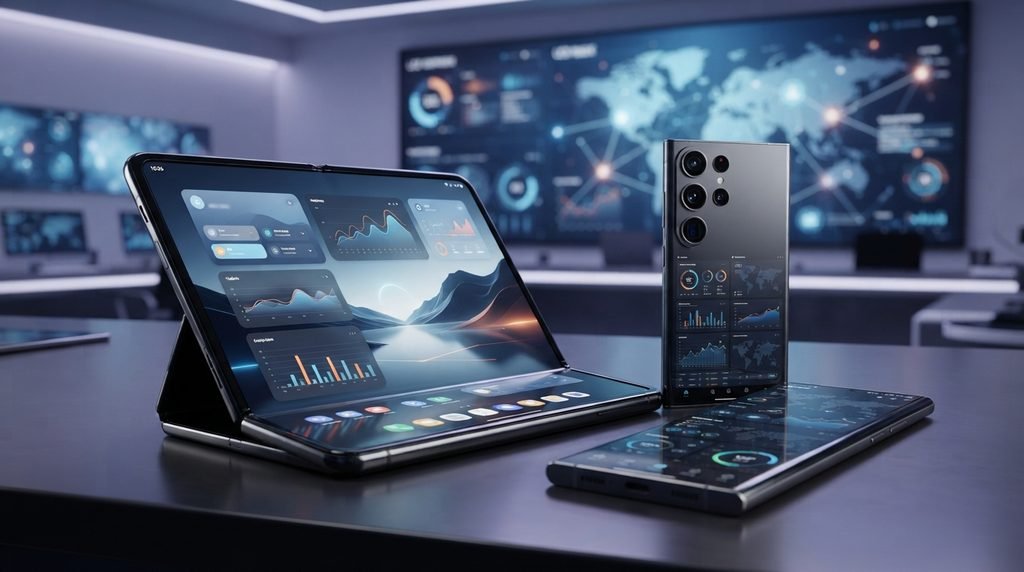

If you follow smartphones closely, 2026 has been one of the most interesting years in recent mobile history. The smartphone market is no longer simply about getting a faster processor, adding another camera, or making the display slightly brighter. Manufacturers are now competing to make phones more intelligent, more flexible, more personal, and, in some cases, completely different from the traditional slab-shaped phone we have used for years.
The biggest stories so far include Apple’s entry into foldable phones, Samsung’s increasingly sophisticated Galaxy Z lineup, Google’s Pixel 11 family and its deeper Gemini integration, and the continuing race to make artificial intelligence useful in everyday mobile life. Apple officially introduced the iPhone Duo, its first foldable iPhone, on September 9, 2026. Samsung had already expanded its foldable range with the Galaxy Z Fold8 Ultra, Galaxy Z Fold8 and Galaxy Z Flip8 in July. Google also introduced four Pixel 11 phones in August.
So, what is actually changing for ordinary phone users? And which trends should you pay attention to before buying your next smartphone? Let’s take a closer look at the latest mobile phone news and updates in 2026.
Why 2026 Is a Big Year for Smartphones
For years, smartphone upgrades followed a fairly predictable formula. A new phone would arrive with a slightly better camera, a faster chip, a larger battery and perhaps a redesigned body. In 2026, however, the industry is moving in several directions at once. AI, foldable displays, advanced photography, improved battery efficiency and smarter software are becoming major selling points.
This shift is important because people are beginning to expect their phones to do more than simply run applications. A modern smartphone can help organize information, edit photos, summarize content, translate conversations, recognize objects and provide contextual assistance. Google’s Pixel 11 lineup, for example, is designed around what Google calls Gemini Intelligence, while Samsung is emphasizing agentic AI experiences across its newest foldables.
At the same time, hardware innovation has not disappeared. Samsung’s Galaxy Z Fold8 Ultra reaches an 8-inch unfolded display while weighing 215 grams, according to Samsung. The standard Galaxy Z Fold8 weighs 201 grams, making the company’s latest foldables considerably more practical than many earlier generations.
That combination of smarter software and more ambitious hardware is what makes 2026 particularly exciting.
Artificial Intelligence Is Becoming a Core Phone Feature
AI is no longer something hidden behind a separate application. In 2026, smartphone manufacturers are trying to integrate it directly into the operating system and everyday user experience.
Apple’s latest iPhone 18 Pro models use Apple Intelligence and Siri AI, while Google’s Pixel 11 family is built around Gemini capabilities. Samsung is also pushing agentic AI, where the goal is not merely to answer a question but to help perform a sequence of tasks.
This could eventually change how people interact with their phones. Instead of opening several apps manually, a user might simply describe what they want and let the phone handle parts of the process. The important question, though, is whether these AI tools genuinely save time. That’s the standard consumers should use when judging AI features—not simply whether a phone has the word “AI” printed on its box.
Foldable Phones Are Moving Into the Mainstream
The foldable-phone story has been developing for several years, but 2026 may be the year when foldables receive their biggest mainstream push yet.
Samsung has continued to invest heavily in the category, launching the Galaxy Z Fold8 Ultra, Galaxy Z Fold8 and Galaxy Z Flip8. Apple has now entered the category with the iPhone Duo, giving consumers another major option.
Apple’s entry is particularly significant because competition tends to accelerate innovation. When multiple major manufacturers compete for the same customers, improvements in hinges, durability, displays, cameras, battery life and software usually follow.
Apple’s Biggest Mobile Developments in 2026
Apple’s September 2026 announcements have dominated smartphone discussions. The company introduced the iPhone 18 Pro and iPhone 18 Pro Max, while also revealing something many Apple fans had been waiting years to see: the first foldable iPhone.
Apple’s official newsroom says the iPhone 18 Pro models bring upgrades to the camera system, performance, battery life and intelligence features. The devices use Apple’s A20 Pro chip and a redesigned thermal system.
For smartphone buyers, this matters because Apple’s hardware and software ecosystem can make a specification sheet less important than the overall experience. A phone does not need to win every individual specification battle if its operating system, applications, accessories and services work together smoothly.
iPhone 18 Pro and iPhone 18 Pro Max
The iPhone 18 Pro and iPhone 18 Pro Max are among the biggest traditional flagship launches of 2026.
Apple says the new models feature a 48MP Fusion Main camera with variable aperture, new camera controls, A20 Pro processing and a next-generation vapor chamber designed for sustained performance. The phones also run iOS 27 and include new Apple Intelligence and Siri AI capabilities.
This tells us something important about where flagship smartphones are heading. Performance is no longer simply about benchmark scores. Phones need to maintain performance during gaming, photography, video recording and AI workloads without becoming uncomfortable to hold or draining the battery too quickly.
The camera system is another major area of competition. Variable aperture gives photographers additional control over how the camera handles different lighting situations. For everyday users, the benefit is simpler: better flexibility when shooting photos and videos in different environments.
Apple Introduces Its First Foldable iPhone
The iPhone Duo is arguably the biggest smartphone announcement of Apple’s 2026 lineup.
According to Apple, the Duo has a 5.4-inch outer display and a 7.6-inch inner display when unfolded. It uses Apple’s A20 Pro chip, a titanium construction and a redesigned iOS 27 experience intended specifically for the foldable format. Pre-orders are scheduled to begin October 16, with availability starting October 23 in the first group of markets.
Apple is entering a market where Samsung and Chinese manufacturers already have years of experience. That means Apple cannot simply offer a folding screen and expect consumers to be impressed. The real challenge is making the foldable format feel useful rather than gimmicky.
The larger internal display could make multitasking, gaming, video consumption and productivity more comfortable. Apple also says the device will support Apple Pencil later in the year, which could make the larger screen more useful for notes and creative work.
Samsung Galaxy Phones Continue the Foldable Race
Samsung remains one of the most important companies in the foldable-phone market, and its 2026 Galaxy Z lineup shows that the company is not slowing down.
In July, Samsung introduced the Galaxy Z Fold8 Ultra, Galaxy Z Fold8 and Galaxy Z Flip8. The company describes the lineup as three different approaches to foldable phones, ranging from productivity to immersive content and compact self-expression.
Samsung also reported that pre-orders for the new Galaxy Z lineup increased by more than 30% compared with the previous generation, suggesting that interest in foldable devices continues to grow.
Galaxy Z Fold8 Ultra
The Galaxy Z Fold8 Ultra is designed to push the large foldable concept further.
Samsung says it has an 8-inch main display, measures 4.1mm when unfolded and weighs 215 grams. It uses a Snapdragon 8 Elite Gen 5 for Galaxy processor and a 5,000mAh battery.
Those numbers matter because early foldable phones often forced consumers to compromise heavily on thickness and weight. The industry is gradually trying to eliminate that compromise.
Imagine carrying a device that can function like a normal phone during a commute but transform into something closer to a small tablet when you sit down to work. That is the central appeal of large foldables.
Samsung is also combining the hardware with agentic AI. Its examples include using Gemini to analyze an image and help find a nearby hotel while the user continues using other applications.
Galaxy Z Flip8 and Everyday AI
The Galaxy Z Flip8 takes a different approach. Instead of turning a phone into a tablet, it folds a conventional smartphone into a smaller form factor.
Samsung says the Flip8 weighs 180 grams and is 6.1mm thick when unfolded. Its FlexWindow lets users access information and features without completely opening the phone.
This is an interesting direction because not everyone wants a huge screen. Some buyers simply want a compact phone that becomes easier to carry.
The Flip8 also demonstrates how AI is becoming part of the foldable experience. Samsung’s Now Brief, for example, can surface information such as weather, schedules and notifications through the cover display.
Google Pixel 11 Brings More AI to Android
Google’s Pixel 11 family is another major part of the 2026 smartphone story.
Google introduced the Pixel 11, Pixel 11 Pro, Pixel 11 Pro XL and Pixel 11 Pro Fold in August. The company says the devices include major camera upgrades, enhanced durability and more proactive Gemini capabilities.
The Pixel 11 family is powered by Google’s Tensor G6 chip, with the company placing significant emphasis on AI-powered features rather than simply raw processing performance.
Tensor G6 and Gemini Intelligence
One of the most interesting Pixel 11 features is Magic Capture. Google says the feature can analyze almost 400 frames during a capture session to select well-timed photos and video moments, with optional light editing such as cropping, straightening or unblurring.
That is a good example of how computational photography is changing. In the past, taking a great photograph depended heavily on timing and technical skill. Modern phones increasingly try to handle some of that work automatically.
Google also introduced features such as Rambler for voice transcription and HiLight for keeping users connected even when the phone is face down.
The Pixel 11 lineup is therefore less about one revolutionary specification and more about building an ecosystem where the phone quietly assists the user throughout the day.
Cameras, Batteries and Performance in 2026
The smartphone camera battle is far from over. Apple is improving its camera hardware, Google is using AI to improve the moment of capture, and Samsung continues to combine advanced sensors with computational photography.
But consumers should look beyond megapixel numbers. A 200MP camera does not automatically produce better photographs than a 50MP camera. Sensor size, image processing, stabilization, lenses, software algorithms and lighting all matter.
Battery technology is another area receiving increasing attention. Larger displays, faster processors and AI workloads all consume power, so manufacturers have to improve efficiency at the same time they add features.
Thermal management is becoming especially important for flagship phones. Apple highlights its new vapor-chamber design for the iPhone 18 Pro, while Samsung is using powerful processors and larger batteries in its premium foldables.
For buyers, this means a phone with slightly lower benchmark performance can actually be a better everyday device if it stays cool, maintains performance and lasts longer between charges.
What Smartphone Buyers Should Watch Next
The biggest mistake a buyer can make in 2026 is choosing a phone purely because it is the newest model.
Technology moves quickly, but that does not mean every new feature is useful to every person. A student, photographer, gamer, business professional and casual social-media user may need completely different things from a smartphone.
Before purchasing, consider the camera quality, battery life, software update policy, display, processor, storage, repairability, network compatibility and, most importantly, the price.
Prices and Value
Premium smartphones are becoming increasingly expensive, particularly when foldable displays are involved. Apple’s iPhone Duo, for example, starts at $1,999, while Google’s Pixel 11 lineup starts at $899 for the standard model and reaches $1,899 for the Pixel 11 Pro Fold.
That makes the mid-range market extremely important.
For many users, a previous-generation flagship or a strong mid-range phone can provide most of the experience for considerably less money. The smartest purchase is not necessarily the phone with the highest price—it is the phone that provides the features you actually use.
Software Support and AI Features
Software support is becoming just as important as hardware.
A phone that receives years of security updates and operating-system improvements can remain useful for much longer. AI features also need ongoing software development, meaning a phone’s capabilities can change after purchase.
When comparing smartphones in 2026, ask yourself a simple question: How useful will this phone still be two or three years from now?
That question can save you more money than chasing every launch-day specification.
Conclusion
The latest mobile phone news and updates in 2026 show an industry entering another major transition. AI is becoming deeply integrated into smartphone software, foldable phones are becoming thinner and more capable, and flagship cameras are relying increasingly on sophisticated computational photography.
Apple’s iPhone Duo has brought a major new competitor into the foldable market, while Samsung continues to expand its leadership with the Galaxy Z Fold8 Ultra, Fold8 and Flip8. Google is taking a different but equally important approach with the Pixel 11 family, putting Gemini Intelligence and AI-assisted photography at the center of the experience.
For consumers, that competition is good news. It means smartphone companies have to work harder to give people a reason to upgrade.
The next few years could be even more interesting. Phones may become thinner, smarter and more context-aware, while foldable designs could become increasingly normal rather than experimental. The real winner, however, will be the technology that makes everyday life easier—not simply the phone with the longest specification sheet.
For more latest mobile phone news, smartphone launches, Android updates, iPhone news and technology updates, keep following UBDQ Online.