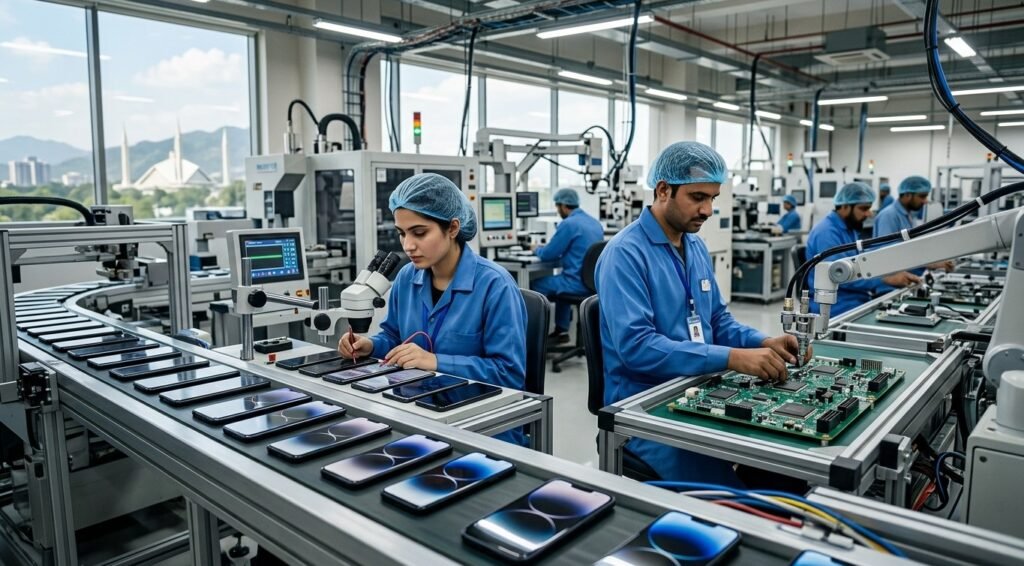

Pakistan’s mobile phone industry has undergone a major transformation over the past few years. What was once heavily dependent on imported finished smartphones is increasingly becoming an assembly and manufacturing market, with local companies producing millions of handsets every year.
The Pakistan mobile assembly market 2025-2026 is particularly interesting because the country is moving beyond simple handset assembly and is now discussing larger-scale manufacturing, localization, exports, refurbishment, and integration into international supply chains.
According to Pakistan Telecommunication Authority (PTA) data reported for 2025, local manufacturers assembled approximately 30.21 million mobile phones during the year. Around 15.64 million of these were smartphones, while 14.57 million were 2G devices. Local assembly accounted for approximately 93% of mobile-phone consumption in Pakistan during 2025.
The numbers show that local assembly is no longer a small part of Pakistan’s smartphone ecosystem. It has become an important component of the country’s mobile market.
Pakistan Mobile Assembly Market in 2025
The year 2025 was a mixed one for local mobile manufacturing. While production remained extremely high, annual output declined compared with 2024.
Local manufacturers assembled around 30.21 million mobile phones in 2025, compared with approximately 31.38 million units in 2024. This represents a decline of about 4%. Analysts attributed part of the slowdown to weaker consumer demand and longer smartphone replacement cycles.
However, the decline does not mean Pakistan’s mobile assembly industry is shrinking.
In fact, locally assembled phones continued to dominate the domestic market. Around 93% of mobile-phone consumption in 2025 was fulfilled through local manufacturing and assembly, demonstrating how important domestic production has become.
Another important development was the growing share of smartphones. Of the 30.21 million locally assembled devices in 2025, approximately 15.64 million were smartphones, while 14.57 million were traditional 2G phones.
This shift is important because it shows that Pakistan’s assembly industry is gradually moving toward higher-value devices rather than relying only on basic feature phones.
What Is Driving Mobile Phone Assembly in Pakistan?
Several factors have contributed to the growth of the Pakistan mobile assembly market.
Government Support
Government policy has played an important role in encouraging local mobile manufacturing.
Pakistan’s Mobile Device Manufacturing Policy introduced incentives for companies manufacturing devices through CKD and SKD arrangements. The policy was designed to encourage localization, develop supporting industries and reduce dependence on imported finished handsets.
Under the framework, approved local manufacturers can import mobile-phone components in CKD/SKD form under specified conditions, while certain duties and taxes receive preferential treatment.
The broader objective is not simply to put phones together inside Pakistan. The long-term goal is to develop an ecosystem involving components, engineering, packaging, research and development, skilled workers and eventually exports.
Rising Smartphone Demand
Pakistan has a huge consumer market for affordable smartphones.
Consumers increasingly want better cameras, larger displays, stronger processors, 4G and 5G connectivity, larger batteries and improved software. Local assembly allows manufacturers to respond to this demand while reducing their dependence on importing completely built units.
Brands operating assembly facilities in Pakistan can also potentially reduce supply-chain costs and respond more quickly to local market conditions.
Import Policies and Tariff Differences
Another major factor is the difference between the treatment of completely built units and locally assembled CKD/SKD devices.
The government’s manufacturing policy has historically attempted to create a tariff advantage for local assembly compared with importing finished phones. The purpose is to make domestic production more commercially attractive.
This approach has encouraged international and local brands to establish or expand assembly operations in Pakistan.
What Happened in 2026?
The first part of 2026 provided encouraging signs for the local mobile assembly sector.
According to PTA data cited by Topline Securities, Pakistan’s local manufacturers assembled 2.79 million mobile phones in March 2026, up 20% compared with March 2025. During the first quarter of 2026, local manufacturing and assembly reached approximately 7.36 million units.
The same data showed that local manufacturing fulfilled approximately 86% of Pakistan’s mobile-phone demand during the first quarter of 2026.
This is a strong indication that local assembly remains central to the country’s mobile-phone supply chain.
Interestingly, the brands being assembled locally are not limited to one or two manufacturers.
During the first quarter of 2026, the leading locally assembled brands included VGO TEL, Infinix, Vivo, Samsung, Itel, Tecno, Nokia, X Mobile, OPPO and Realme.
This variety is important because it shows that Pakistan’s assembly ecosystem supports both international and domestic brands.
Pakistan’s Mobile Manufacturing Policy 2026-33
One of the biggest developments to watch is Pakistan’s proposed Mobile & Electronics Devices Manufacturing Policy 2026-33.
In February 2026, the Engineering Development Board finalized a framework for the policy and prepared it for presentation to the Prime Minister for approval. The government described the initiative as a step toward large-scale local manufacturing of mobile phones and electronic devices.
The new framework is expected to focus on more than domestic assembly.
Its broader goals include:
- Increasing local manufacturing
- Developing the electronics industry
- Creating skilled employment
- Encouraging investment
- Increasing exports
- Developing local components
- Strengthening Pakistan’s industrial base
- Connecting local manufacturers with international supply chains
If successfully implemented, this could mark an important transition from an assembly-focused industry toward a more integrated manufacturing ecosystem.
From Assembly to Manufacturing
It is important to understand the difference between mobile phone assembly and complete manufacturing.
In an assembly model, many major components are imported in CKD or SKD form and assembled inside Pakistan. The finished product is then tested, packaged and sold locally.
True manufacturing requires deeper localization.
This can include producing or sourcing components such as:
- Printed circuit boards
- Batteries
- Chargers
- Cables
- Casings
- Displays
- Camera modules
- Speakers
- Packaging materials
- Other electronic components
Pakistan’s existing policy framework has already emphasized localization and development of allied industries.
The challenge for the next stage will be convincing more suppliers and component manufacturers to invest in Pakistan.
Why Local Mobile Assembly Matters for Consumers
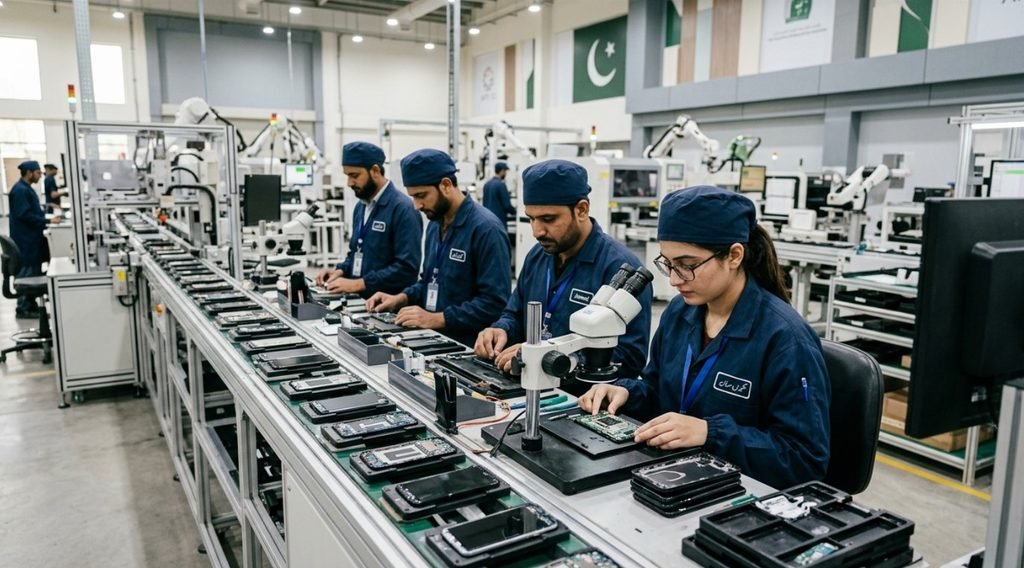
The growth of local assembly can benefit Pakistani consumers in several ways.
First, it can improve product availability. Manufacturers with local operations may be able to maintain better stock levels and respond faster to market demand.
Second, local production can create employment opportunities for engineers, technicians, factory workers, logistics companies and other supporting businesses.
Third, a stronger domestic industry could eventually support more competitive pricing.
However, local assembly does not automatically mean every smartphone will become cheaper. Component prices, exchange rates, taxes, energy costs, logistics and global semiconductor prices all influence the final retail price.
Consumers should therefore look at the overall market rather than assuming that locally assembled phones will always be the least expensive option.
Apple and Google Remain an Important Exception
Despite the dominance of local assembly, Pakistan still imports some smartphones that are not manufactured locally.
This became particularly visible in FY2025-26. Pakistan Customs reported approximately 32 million mobile phones imported across categories during the fiscal year, broadly similar to the previous year’s total.
However, around four-fifths of the reported import value was associated with CKD and SKD kits used by registered local assemblers and manufacturers. Completely built units represented roughly Rs100 billion of the approximately Rs520 billion total mobile-phone import value.
The government also noted that imports of high-end smartphones such as Apple iPhones and Google Pixel devices increased because these products were not being manufactured locally.
This highlights an important point: Pakistan is not completely replacing imports. Instead, the market is developing a combination of local assembly and selective finished-device imports.
Pakistan Wants to Become an Export Hub
The next major opportunity could be exports.
In July 2026, Pakistan’s Commerce Minister invited Samsung to explore Pakistan as a regional manufacturing, refurbishment and export hub for mobile phones. The government specifically encouraged the company to consider exporting Pakistan-manufactured smartphones to emerging markets, including African countries.
This is a significant development.
Pakistan’s large domestic market can provide a foundation for manufacturers, but exports could create a much larger opportunity.
If local factories can produce devices at competitive prices and meet international quality standards, Pakistan could potentially supply smartphones to markets outside the country.
The development of refurbishment facilities could also create another industry around used smartphones and circular electronics.
Challenges Facing Pakistan’s Mobile Assembly Industry
Despite strong growth, several challenges remain.
1. Dependence on Imported Components
Pakistan still depends heavily on imported components and manufacturing inputs. This means exchange-rate movements and international supply-chain disruptions can directly affect local production costs.
2. Limited Component Localization
Assembling phones locally is only the first step. Developing a competitive local component industry will require investment, technology transfer, skilled labor and long-term policy stability.
3. Consumer Purchasing Power
Pakistan’s economic conditions affect smartphone demand. When consumers face higher living costs, they may keep their existing phones for longer instead of upgrading.
4. Global Competition
Pakistan is competing with established electronics manufacturing markets such as China, Vietnam and India. These countries already have extensive supplier networks and mature manufacturing ecosystems.
5. Policy Consistency
Manufacturers need predictable policies. Long-term investment decisions are difficult when tax structures, import rules or incentives change frequently.
What Does the Future Look Like?
The outlook for the Pakistan mobile assembly market 2025-2026 is cautiously positive.
The country’s local assembly industry has already reached a scale where it supplies the majority of domestic mobile-phone demand. The next challenge is to increase value addition.
The government’s 2026-33 manufacturing framework, combined with continued private-sector investment, could push the industry toward more sophisticated manufacturing.
Pakistan could eventually develop a stronger electronics ecosystem around smartphones, including component production, testing, packaging, repair, refurbishment and exports.
The biggest opportunity may be in affordable smartphones. Pakistan has a large population of price-conscious consumers, and manufacturers that can offer reliable devices at competitive prices are likely to remain important players.
At the same time, premium smartphone imports will probably continue because certain international flagship brands are not currently manufactured locally.
Final Verdict
The Pakistan mobile assembly market 2025-2026 is entering a new phase.
The industry is no longer simply about assembling inexpensive phones for the domestic market. Pakistan is increasingly discussing localization, large-scale manufacturing, electronics development, refurbishment and exports.
With more than 30 million phones locally assembled in 2025 and millions more produced during the first quarter of 2026, the foundation is already in place.
The real test will be what happens next.
If Pakistan can attract component manufacturers, maintain consistent policies, improve technical skills and encourage brands to export from the country, mobile manufacturing could become a much more important part of Pakistan’s industrial economy.
For consumers, manufacturers and technology companies, the next few years could therefore be some of the most important in the history of Pakistan’s mobile-phone industry.